Thousands of migrants have been able to obtain a residence and work permit in Spain thanks to the extraordinary regularization process of 2026, regulated by Royal Decree 316/2026. However, these permits are initially valid for one year. This raises one of the most important questions: what happens when that year is up, and what requirements must be met to continue living and working legally in Spain?
The answer depends mainly on each person’s employment, financial and personal circumstances.
In this article, we explain the conditions set out in the current regulations, the documents worth preparing and the deadlines you must not miss.
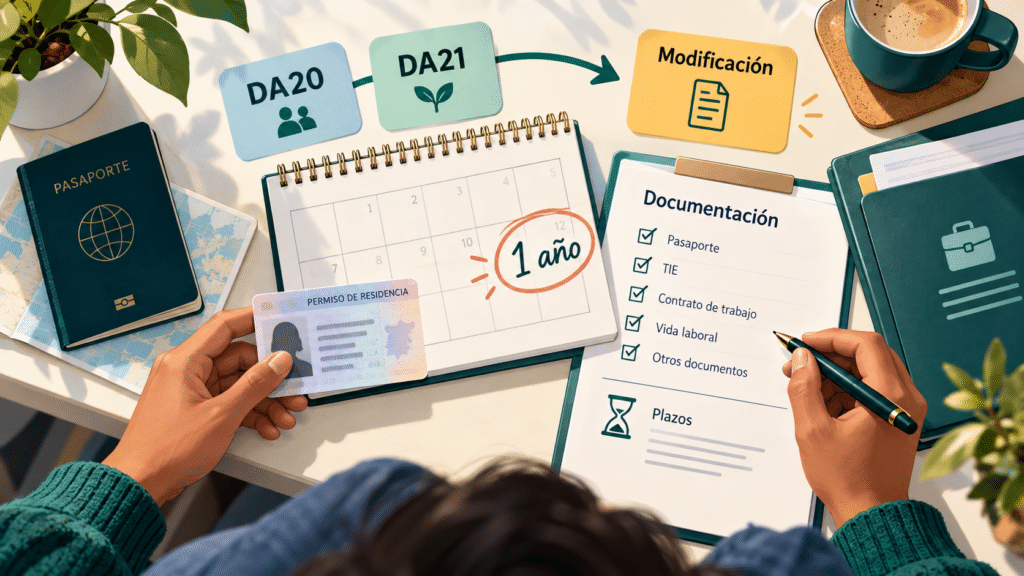
Quick answer: How can a DA20 or DA21 residence permit be renewed?
As a general rule, people who obtained their permit under DA20 or DA21 must apply to change it to a residence and work permit, in accordance with Article 191 of the Immigration Regulations.Key points:
- Standard deadline: within the two months before the permit expires. Late filing: within the three months after expiry, although this may lead to a penalty.
- Change of status form: Form EX-26.
- Requirements: demonstrate one of the situations set out in Articles 80 or 86 of the Regulations, as applicable. New permit duration: usually four years when Article 191.3 applies and its requirements are met.
- Exceptional alternative: apply for a one-year or four-year extension if changing the permit is not possible and the specific conditions are met.
Important: it is not enough to apply for a new foreign national identity card (TIE). You must first obtain a change or extension of the residence permit.
1. What is the difference between DA20 and DA21 residence permits?
The 2026 extraordinary regularization established two main routes.
| DA20 | DA21 | |
|---|---|---|
| DA20: For people who applied for international protection before 1 January 2026, among other requirements. | ||
| One-year permit based on extraordinary arraigo. | ||
| Allows employment and self-employment. | Allows employment and self-employment. | |
| It can be changed under Article 191. | It must be changed under Article 191 as the standard route. |
Although access requirements differed, both permits follow a very similar continuation process as they approach expiry.
Both also allow holders to work from the moment they are granted, without territorial, occupational or sector restrictions.2. When does the year of residence start?
This point is particularly important.The regulations state that, once the final permit is granted, its effects are backdated to the date on which the regularization application was submitted.
Therefore, do not assume that the year starts on the date you receive the favourable decision or collect your TIE.
Check the start date and expiry date recorded in your case file and residence documents.For example, someone who filed their regularization application in April 2026 may have to change their permit in spring 2027, even if they received the favourable decision several months later.
SenValos tip: Check the dates on your permit as soon as you receive the favourable decision. Do not wait until the card is close to expiry.3. Deadlines for changing a DA20 or DA21 permit
Additional Provisions 20 and 21 set a specific deadline for applying to change the permit.
Two months before expiryThis is the standard and recommended application period.
Worked exampleIf your permit expires on 20 May 2027, you can apply to change it from 20 March 2027.
An application filed within this period extends the validity of the existing permit until a decision is made.
This allows you to remain lawfully resident while the immigration office processes the application.Three months after expiry
The regulations also allow you to apply to change the permit within three months after it expires.
In the example above, the last day of that period would be 20 August 2027.However, applying after the standard deadline may result in administrative penalty proceedings for late filing.
Although an application filed within those three months also extends the previous permit until a decision is made, it is advisable to avoid letting the permit expire.Should you wait until you have completed exactly one year?
No. You can apply to change the permit during the two months before it expires.
In addition, Migration Management Guideline 1/2025 of the Directorate-General for Migration Management expressly allows applications during this period by holders of residence permits valid for one year or more.This avoids having to wait until the very last day of the permit’s validity.
4. What requirements must be met to change residence status?The main route for people who obtained a DA20 or DA21 permit is Article 191.3 of the Immigration Regulations.
Since both permits are valid for one year and already allow work, applications to change them may, where applicable, be assessed under the conditions in Articles 80 and 86.
There is no single employment requirement that applies to everyone. Different circumstances may qualify a person to change their permit.Case 1. People working as employees
The simplest situation is usually when someone is working and can provide evidence of their employment.
Options under Article 80 include:A. Maintain an employment relationship.
The regulations recognize continued employment as a ground for renewal. For DA20 and DA21 permits, the immigration office must assess whether this applies to a change of status, bearing in mind that the original permit was not always granted on the basis of a specific job contract.B. Have worked for at least three months during the year.
Working for those three months alone is not enough. At least one of the legally established circumstances must also apply, such as:
- Have a new contract and be registered with Social Security or in an equivalent status. Have a new contract that meets the regulatory requirements.
- Have lost the job for reasons beyond their control and provide evidence of continuous jobseeker registration since then, as required.
C. Have worked and been registered with Social Security for at least nine months in a 12-month period.
This is another situation expressly provided for in Article 80.D. Receiving unemployment benefits.
A permit change may be possible if the person receives contributory unemployment benefit or public assistance intended to support social or labour-market integration, in the cases provided for by law.E. Having certain family financial resources.
The rules also cover cases where a relative who meets the conditions in Article 66 has the financial means to sponsor the applicant through family reunification.
Specific provisions also apply in certain cases of gender-based or sexual violence that have affected continuity of employment.A person does not have to meet all these conditions at once. They must show that at least one condition relevant to their situation applies.
Case 2. Self-employed people
People engaged in self-employment may apply to change their permit under the conditions in Article 86.Examples include continuing the business activity, recognition of entitlement to protection for cessation of activity, and certain cases involving family financial dependence or involuntary termination of a professional activity.
For people who continue working as self-employed, it will be especially important to keep:
- Proof of registration in the relevant Social Security scheme.
- Documents relating to the business activity.
- Tax returns and invoices.
- Evidence that the activity is continuing and that applicable obligations are being met.
The supporting documents will depend on the ground used to apply for the change.
Case 3. People who have lost their jobsLosing a job during the first year does not automatically mean losing the possibility of changing residence status.
The regulations cover certain unemployment situations, previous contribution periods, benefits and family circumstances.
Before concluding that someone cannot change their permit, review their complete employment record, why their contracts ended and their status with the public employment service.Registering as a jobseeker can be particularly important in some cases, but registration on its own does not guarantee approval of the change.
Case 4. People who have not been able to find work
This situation will require particularly careful assessment.Some people were granted DA20 or DA21 permits because of family circumstances, vulnerability or their connection to an international protection procedure, without having a job.
If, as expiry approaches, they do not meet any of the conditions for changing status under Article 191, it may be necessary to consider the exceptional extensions specifically provided for DA20 and DA21 permits.5. Will the new residence permit last four years?
Yes, when the change of status is granted under Article 191.3 of the Immigration Regulations.
This Article provides that, if the person meets the conditions for changing status after holding a residence permit valid for at least one year that already allowed them to work, the new permit will be valid for four years.This is an important difference from the initial residence permit granted under the extraordinary regularization process, which is valid for one year.
However, a four-year term is not automatic: the relevant requirements must first be demonstrated.Other types of change covered by Article 191, with different requirements, may result in a one-year permit.
6. Documents needed to change DA20 or DA21 residence status
Documents should be tailored to each applicant’s circumstances. As a practical guide, prepare the following.Common documents
- Duly completed Form EX-26.
- Complete copy of a valid passport, travel document or registration certificate, as applicable.
- Decision granting the DA20 or DA21 residence permit.
- Copy of the TIE, if it has already been issued.
- Evidence supporting the ground for changing the permit. Proof of payment of the applicable fees.
- Representation documents, if the application is submitted through a representative.
Passport alert: During the 2026 extraordinary regularization, certain expired documents were accepted. Do not assume this exception will automatically apply to ordinary changes of status in 2027. Check that your document is valid and review any special instructions that may apply to your nationality.
Documents by employment situation
| Situation | Required documentation |
|---|---|
| Employed | Current employment contract, employment record and proof of registration with the Social Security system. |
| Change of company | New contract, registration or documents that substantiate the applicable circumstance. |
| Work during part of the year | Employment record, contracts, termination documents and other evidence supporting the relevant Article 80 circumstance. |
| Involuntary unemployment | Contract termination, registration as a jobseeker, and any other required supporting documents. |
| Unemployment benefit | Decision or certificate confirming the benefit awarded. |
| Self-employment | Registration, tax records, invoices and evidence that the business is ongoing. |
| Family financial dependence | Documents proving the family relationship and financial resources. |
| Children of compulsory school age in your care | Proof of school enrolment where applicable. |
This table is for guidance: not every document is required from every person. As a general rule, applicants should not be asked to resubmit documents already provided as part of the initial regularization.
The administration can verify certain information ex officio and must comply with Article 28 of Law 39/2015 on documents already held by public authorities. 7. What if the residence permit cannot be changed? Exceptional extensions
Royal Decree 316/2026 provides an alternative for DA20 or DA21 permit holders who cannot qualify for the standard change of status.
This is not an automatic renewal. First, it must be established that the change of status is genuinely not possible, and then the extension requirements must be met.One-year exceptional extension
It may be granted if either of the following two situations is established:
First option: active job search.The person must show that they are actively seeking work and are properly registered with the public employment service.
For example, in Galicia, keep the Emprego Galicia registration up to date and retain evidence of the steps taken to find work.Second option: integration effort report.
A favourable report from the competent regional authority may be submitted; it must expressly recommend the extension.
Among other things, the report may consider participation in training and learning the official languages of the region.If granted, this extension will last one year.
Four-year exceptional extension
The regulations provide another option where duly justified circumstances prevent the person from accessing employment.These include:
- Serious illness or disability of the applicant. Certain cases of serious illness or disability affecting the applicant’s spouse or dependent children covered by the law, where this prevents access to employment.
- Having reached the statutory retirement age.
In these cases, if the requirements are met and the extension is granted, it will last four years.
It is not enough to state that there is an illness, disability or family circumstance: the specific facts and how they prevent access to employment must be evidenced.
Which form is used for the extension?The specific forms for the extraordinary regularization expressly provide for these options:
- EX-31: for extensions of permits granted under DA20. EX-32: for extensions of permits granted under DA21.
Do not confuse these with Form EX-26, which is used for the standard change of a residence permit.
8. Where should you submit the change application, and what fees must be paid?
The standard change application is processed by the Immigration Office responsible for the applicant’s place of residence.Applications may be submitted through available electronic channels, such as the Mercurio platform, or through any other legally permitted filing channel.
Form EX-26 is used for the change of status.For fees, check the applicable category on Form 790-052 and, where required for work permits, Form 790-062; the employer may be responsible for payment.
Check the amounts and fee categories when you file the application.
The general decision period for a change application is three months. If no decision is issued within that period, the applicable negative administrative silence rules apply, without affecting the administration’s duty to decide.Once the new permit is granted, you must apply for a new TIE from the National Police within the applicable deadline and under the relevant conditions, usually within one month of the relevant date.
9. What should residents in Galicia bear in mind?Residents in Galicia can prepare some particularly useful documents in advance.
Emprego Galicia. If the person loses their job, check as soon as possible whether they need to register as a jobseeker. In some cases, maintaining that registration is an important requirement.
Integration effort report. The Xunta de Galicia has procedure BS663A for requesting this report for temporary residence renewals.Before requesting it for a DA20 or DA21 extension, check with the competent authority that it applies to the specific case and confirm the document requirements.
Training. Keep certificates from Spanish and Galician language courses, work-related skills courses and other training related to integration.
Social services. In cases of illness, disability, family difficulties or vulnerability, specific reports documenting the circumstances and their consequences may be needed.Remember that the vulnerability report used to obtain a DA21 permit initially does not automatically replace the integration effort report that may be needed for a later extension.
10. Frequently asked questions about changing DA20 and DA21 permits
Do I need an employment contract to change my residence status?Not in every case.
Article 80 covers different employment situations, benefits and family circumstances. A contract may be important, but it is not a universal requirement for every change of status.Is having paid contributions for three months enough?
Not necessarily. When relying on the three months of work route, at least one of the additional conditions set out in Article 80 must also be met.
< 2 >
< 4 >
What if I worked for nine months during the year?
Article 80 includes having worked and been registered with Social Security for at least nine months in a 12-month period. You must provide evidence of that period and the relevant documents.
What if I have never worked since I obtained residence?Check whether another route applies based on benefits, family circumstances or other relevant situations.
If the permit cannot be changed, consider whether an exceptional extension may be available for active job search, integration efforts or another legally justified circumstance.Can I keep working while my change application is being processed?
Filing the application within the established deadlines extends the validity of the previous permit until a decision is made.
Keep proof of filing and check the specific conditions attached to your immigration status.If I have a DA21 permit based on vulnerability, do I need to submit the vulnerability certificate again?
There is no general requirement to submit the certificate again to change the permit under Article 191.
What matters is meeting the requirements for the new permit. If an exceptional extension applies, provide the documents specific to that route.Do I need to apply for an arraigo residence permit again?
No. If you already obtained a permit under DA20 or DA21, look into changing or extending it under the rules for continuing that permit, rather than filing a new extraordinary regularization application.
The deadline for initial regularization applications ended on 30 June 2026.What happens if my partner or children also obtained residence permits?
Each permit must be reviewed under its own rules and validity dates. Adults with their own permits may need to follow a separate procedure; different rules may apply to minors.
Do not assume that changing one parent’s permit automatically changes permits held by the rest of the family.11. SenValos recommendations: start preparing for the change before 2027
Although the first extraordinary regularization permits will reach their one-year mark in 2027, we recommend preparing the documents now.It is especially important to:
- Check the permit’s actual expiry date. Keep employment contracts and Social Security registration and deregistration records.
- Check contribution periods using the employment history report.
- Keep jobseeker registration where required and retain evidence of active job search. Keep certificates of training and integration, especially if finding work is difficult.
- Seek advice before the change application window opens if there are unemployment, illness, disability or family circumstances.
The 2026 extraordinary regularization was an important opportunity to obtain legal residence. The next goal is to secure that status and avoid jeopardising its continuity because of missing information or documents.
Need help changing your DA20 or DA21 residence permit?
At SenValos, an NGO, we support migrants with immigration and residence procedures in Spain.If you obtained a permit under DA20 or DA21, we can advise you on the requirements for your case, the documents you need and the deadlines to meet.
Do not wait until your permit expires to check whether you can change it.The best option will depend on your employment, family and personal circumstances.
Official sources and legislation consulted
This article was prepared based on the legislation and guidance available as of 30 October 2026. Since initial status changes will mainly be processed in 2027, check for legislative amendments or new instructions before filing each application.- Real Decreto 316/2026, de 14 de abril: disposiciones adicionales 20.ª y 21.ª.
- Real Decreto 1155/2024, Reglamento de Extranjería: artículos 80, 86 y 191.
- Ministerio de Inclusión: Hoja informativa 55, modificación de autorizaciones de residencia que habilitan a trabajar.
- Migration Management Guideline 1/2025 of the Directorate-General for Migration Management.
- Xunta de Galicia: procedure BS663A, integration effort report.


