In recent days, many reports have appeared about what is commonly known as the Law of Grandchildren. Some people are concerned because they have read that the Supreme Court has “suspended the Law of Grandchildren” or that they could even lose their Spanish nationality.
The situation is more specific.
The Supreme Court has not taken away Spanish nationality from people who already obtained it under the Democratic Memory Law. Nor has it ordered all nationality applications to be suspended.
What it has done is adopt a precautionary measure concerning the right to vote of some Spanish citizens who live outside Spain while it examines the matter and issues a final judgment. (Central Electoral Board)
Let us explain it step by step.
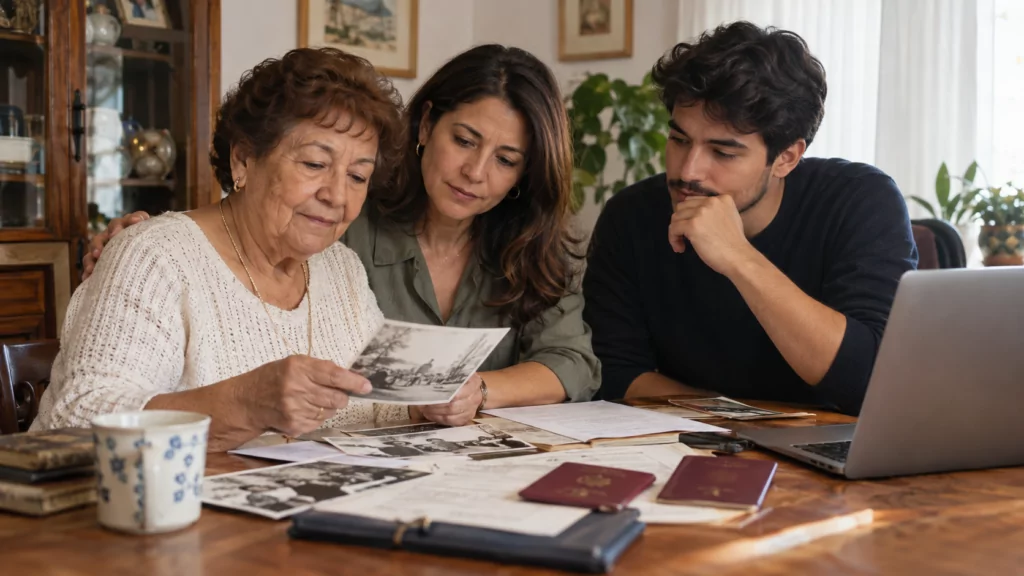
Quick summary: what happened with the Law of Grandchildren?
If you only want to understand the most important points, keep these ideas in mind:
- The so-called Law of Grandchildren is still in force.
- The deadline for submitting new applications ended on 22 October 2025.
- People who correctly requested an appointment within the deadline may still have applications awaiting processing.
- The Supreme Court has adopted a provisional measure concerning registration and electoral effects in the CERA of certain people who obtained Spanish nationality.
- Their Spanish nationality has not been annulled.
- The measure does not affect all situations under the Democratic Memory Law in the same way.
- The judicial proceedings have not yet ended. We will have to wait for the final judgment.
(Ministry of Foreign Affairs)
What is the “Law of Grandchildren” really?
In fact, there is no law officially called the “Law of Grandchildren.”
This name is used to refer to the eighth additional provision of Law 20/2022 of 19 October on Democratic Memory.
This rule created a special route for certain people born outside Spain to obtain Spanish nationality by origin.
Among other cases, it covered children and grandchildren of people who were originally Spanish, descendants of exiled Spaniards, children of Spanish women who lost their nationality by marrying foreigners before the 1978 Constitution, and certain adult children of people who had obtained nationality under the Democratic Memory Law or the earlier Historical Memory Law. (BOE)
Can I still apply for nationality under the Law of Grandchildren?
New applications can no longer be submitted.
The law initially established a two-year period. In July 2024, the Council of Ministers agreed to extend it by one more year. Finally, the period ended on 22 October 2025. (La Moncloa)
This does not mean that all applications had to be completed on that date.
For example, people who correctly requested an appointment before the deadline and obtained the corresponding receipt could later be summoned by the consulate to submit their documents. The Spanish consulates expressly indicated this when the deadline ended. (Ministry of Foreign Affairs)
Therefore:
22 October 2025 = deadline for correctly starting the application.
It does not mean that all pending applications were closed on that date.
So, what did the Supreme Court do in September 2026?
This is the main development.
The Supreme Court is examining two appeals related to the application of this legislation and to a previous decision by the Central Electoral Board.
While it reaches a final decision on the matter, it has adopted precautionary measures.
A precautionary measure is a provisional decision. It applies while the court examines the main issue.
The proceedings include appeals 1013/2026 and 1015/2026. The Central Electoral Board received the Supreme Court documents on 10 September 2026 and agreed to execute them on 14 September. (Central Electoral Board)
Has the Supreme Court taken away Spanish nationality?
No, it has not.
This is probably the most important question.
The decision currently known does not annul nationalities that have already been granted.
What it provisionally regulates is registration and electoral effects in the Register of Spaniards Residing Abroad, known as CERA. (El País)
The CERA is, simply explained, the register containing Spanish citizens who usually live outside Spain and may take part in certain Spanish elections.
Therefore, these are two different things:
hold Spanish nationality and be eligible to vote from abroad through the CERA.
The Supreme Court decision discussed here affects the second of these.
Which people are affected by the decision?
This point is important because the measure does not generally concern everyone who obtained nationality under the Democratic Memory Law.
The court order specifically concerns people who obtained nationality under the first paragraph of section 1 of the eighth additional provision of Law 20/2022. (Central Electoral Board)
There are two situations within this group.
1. People who obtained nationality but were not yet registered in the CERA
Their electoral registration application may continue to be processed.
However, once it is completed, the affected registration may remain suspended until the Supreme Court delivers judgment.
2. People who were already registered in the CERA
In certain cases, the electoral effects of that registration are provisionally suspended.
In other words, the issue concerns the right to participate in elections while the precautionary measure remains in force.
Spanish nationality, however, is not annulled by this decision. (El derecho y el revés)
There is an important exception: descendants of exiles who can prove it.
The Supreme Court itself has established an exception.
The suspension should not apply when the Consular Register can certify that the person:
- was born outside Spain;
- is the daughter, son, granddaughter or grandson of a person who was originally Spanish;
- that person suffered exile for political or ideological reasons, because of their beliefs, or because of their sexual orientation or gender identity;
- and lost or renounced Spanish nationality.
In addition, the evidence must be provided without relying on the presumption of exile set out in the Instruction of 25 October 2022 for certain historical periods. (Central Electoral Board)
On 14 September, the Central Electoral Board ordered Consular Registers to issue these certificates when the requirements are met. (Central Electoral Board)
Subsequently, the Ministry of Foreign Affairs issued instructions to the consular network to identify and certify these cases. (Europa Press)
Why is there now a problem with proof of exile?
To understand it, we need to go back to 2022.
The Democratic Memory Law provided that certain people born outside Spain could apply for nationality if their parents or grandparents were originally Spanish and had lost or renounced their nationality as a consequence of exile. (BOE)
However, the Instruction of 25 October 2022 issued by the Directorate-General for Legal Security and Public Faith later adopted a broader interpretation.
The Instruction understood that the first paragraph could cover two situations: descendants of a father, mother, grandfather or grandmother who were originally Spanish, and, in addition, descendants of people who had lost or renounced their nationality because of exile. (BOE)
It also established a rule to make proof of exile easier.
The Instruction stated that Spanish citizens who left Spain between 18 July 1936 and 31 December 1955 were presumed to be exiles, provided that their departure from Spain could be proven. For departures between 1 January 1956 and 28 December 1978, exiled status had to be proven. (BOE)
Part of the current judicial debate concerns precisely the application of this administrative interpretation.
The Supreme Court has not yet issued its final judgment on the merits of the case.
Does this mean that all granted nationalities will be reviewed?
As of 18 September 2026, that cannot be stated.
The precautionary measure currently known concerns the CERA and the electoral effects of certain registrations.
It does not automatically order the withdrawal of Spanish nationality or declare all nationalities obtained through this route invalid. (Central Electoral Board)
Nor would it be correct to say now that all those nationalities are definitively protected from any future consequence.
The judicial proceedings are continuing, and the Supreme Court’s final judgment will have to be examined.
Until that judgment is issued, it is advisable to avoid messages such as “the Law of Grandchildren has been annulled,” “all nationalities will be withdrawn,” or “nothing else matters.”
None of those statements accurately describes the current situation.
My application is still pending. Will it be suspended?
The precautionary measure that has been issued does not order a general suspension of the processing of nationality applications submitted within the deadline under the Democratic Memory Law.
Therefore, if you correctly submitted your application before the deadline ended, or requested your appointment within the deadline where that system applied, you should continue to monitor communications from the relevant Civil Registry or Consulate.
The September decision focuses on the electoral effects for people who have already obtained nationality under the specific situation identified by the Supreme Court. (Central Electoral Board)
I already have Spanish nationality. Could I lose my passport or ID card?
The known precautionary measure does not order the withdrawal of the passport, ID card, or nationality registration.
It concerns registration and electoral effects in the CERA.
Therefore, a person should not automatically assume that they are no longer Spanish because their electoral registration may be affected.
If you receive a specific communication from the Consulate, Civil Registry, Electoral Census Office, or any other Administration, it is advisable to check exactly what the notification says before taking any action.
Does it affect all ways of obtaining nationality under the Democratic Memory Law?
No, it does not.
The court orders expressly refer to the first paragraph of the eighth additional provision, section 1. (Central Electoral Board)
The eighth additional provision also covers other different situations, such as children born abroad to Spanish women who lost their nationality by marrying foreigners before the 1978 Constitution, and certain adult children of people who previously obtained Spanish nationality by origin. (BOE)
That is why it is important to know under which specific paragraph each person obtained nationality.
Two people who say they obtained nationality through the “Law of Grandchildren” may be in different legal situations.
I live in Spain. Does this also affect my right to vote?
The precautionary measure specifically concerns the Electoral Census of Spaniards Residing Abroad, known as CERA. (Central Electoral Board)
Therefore, this decision should not automatically be applied to every Spanish citizen currently living in Spain who is registered in another type of electoral census.
Each situation must be checked against the person’s actual census data.
How can I find out whether I am registered in the CERA?
The National Statistics Institute provides an online service for checking electoral census registration details.
Interested individuals can check their registration details online if they have an identification system accepted by the electronic office. (INE)
INE electoral census registration check
What should an affected person do now?
There is no need to submit documents indiscriminately.
First, it is essential to know exactly which situation applies to the person:
- check under which provision of the Democratic Memory Law the person obtained nationality;
- check whether they live in Spain or abroad;
- check whether they are registered in the CERA;
- check whether the file actually proves exile or relies on any of the interpretations or presumptions in the 2022 Instruction;
- keep all the documentation used to obtain nationality;
- keep in particular documents related to leaving Spain, residence in another country, consular registration, and any evidence of possible exile;
- review any new notification from the Consulate, Civil Registry, or Electoral Census Office before responding to it.
The Central Electoral Board has already asked Consular Registers to distinguish cases according to how the situation that allowed access to nationality was established. (Central Electoral Board)
Frequently asked questions about the Law of Grandchildren in 2026
Has the Law of Grandchildren been annulled?
No. Law 20/2022 remains in force. What exists is a precautionary measure by the Supreme Court concerning certain electoral effects arising from some nationalities obtained under the eighth additional provision.
Have the descendants of Spaniards had their nationality taken away?
No. The known precautionary decision does not annul those nationalities.
Can I still apply for nationality under the Law of Grandchildren?
As a general rule, no. The period ended on 22 October 2025. People who correctly started the procedure or requested an appointment within the deadline may still have applications being processed. (Ministry of Foreign Affairs)
Can pending applications continue to be processed?
Yes. The Supreme Court measure does not establish a general suspension of the processing of pending nationality applications.
What is the CERA?
It is the Electoral Census of Spaniards Residing Abroad, which includes Spaniards who usually live outside Spain for electoral purposes.
Do all people who obtained nationality under the Law of Grandchildren lose the right to vote?
That should not be stated. The measure concerns a specific situation under the eighth additional provision and also establishes an exception for certain descendants of exiles whose situation can be certified by the Consular Register. (Central Electoral Board)
Is the Supreme Court decision final?
No. It is a precautionary measure. It will be determined by the judgment resolving the judicial proceedings. (RTVE.es)
Do I now have to prove that my grandfather was exiled in order to keep my nationality?
There is currently no general obligation to submit new proof of exile in order to retain all nationalities obtained under this law.
A separate issue is the evidence required to remain outside the electoral suspension established by the Supreme Court in the affected cases.
What may happen from now on?
The Central Electoral Board is implementing the measures ordered by the Supreme Court and has requested the cooperation of the Electoral Census Office and the Consular Registers.
The consulates must identify certain cases and certify those in which exile has actually been established under the terms indicated by the Court. (Central Electoral Board)
After that, we will have to wait for the Supreme Court’s final judgment.
That judgment will make it possible to understand the legal consequences of this proceeding more clearly.
For that reason, SenValos will update this information when a new official decision is published.
Do you need to review your case?
If you obtained nationality under the Democratic Memory Law, still have a pending application, or have received a communication concerning your CERA registration, you should review your documents before taking any action.
At ONGD SenValos, we can help you identify the provision under which you applied for nationality, what documentation is in your file, and whether the new decisions may affect your specific situation.
Important: every case is different and the judicial situation is still ongoing. The information in this article is updated to 18 September 2026.
The legal basis of the so-called Law of Grandchildren is the eighth additional provision of Law 20/2022 and the Instruction of 25 October 2022. (BOE) The implementation of the precautionary measures can be consulted in Agreement 224/2026 of the Central Electoral Board. (Central Electoral Board)
Law 20/2022 on Democratic Memory in the BOE
Instruction of 25 October 2022 on Spanish nationality
Central Electoral Board Agreement 224/2026


